Managing Stop-Loss Costs with Smarter Self-Funded Strategies
For brokers and self-funded employers, stop-loss strategies are becoming a much larger part of the renewal conversation. Rising catastrophic claims, tightening underwriting requirements, and reduced reinsurance capacity are creating new financial pressures, prompting employers to reconsider how they manage healthcare costs and risk.
According to a recent Skyward Specialty white paper, industry estimates suggest that recent reinsurer exits and reductions could remove more than $1.5 billion in effective reinsurance capacity from the medical stop-loss market. Meanwhile, industrywide gross loss ratios reached nearly 86% in 2024, reflecting mounting pressure on underwriting performance.
These developments could translate into higher premiums, stricter contract terms, and greater scrutiny of employers' claims experience.
Scott Brewster, Executive Vice President of Sales and Marketing for 90 Degree Benefits’ Louisiana, Mississippi, and Dallas, Texas offices, says the effects are already influencing conversations with brokers and employers.
"Looks like 20% increase is the new FLAT," Brewster said, describing a sentiment he frequently hears from employers facing difficult stop-loss renewals.
With 2027 approaching, brokers have an opportunity to help clients evaluate stop-loss strategies that address both exposure and the underlying costs driving it.
Why Is the Stop-Loss Market Facing More Pressure?
A thoughtful stop-loss strategy protects self-funded employers against unexpectedly large medical claims. However, as the frequency and severity of high-cost claims increase, carriers are reconsidering how they price and manage that risk.
Skyward identified several contributors to this trend in their report, including oncology treatments, cardiovascular conditions, and costly injectable and infusion-based therapies. Emerging cell and gene therapies add further complexity, with individual treatments potentially costing hundreds of thousands or even millions of dollars.
At the same time, declining reinsurance capacity is creating pressure for carriers to adopt more selective underwriting practices.
For employers, these developments reinforce the importance of managing healthcare spending throughout the plan year rather than waiting until renewal.
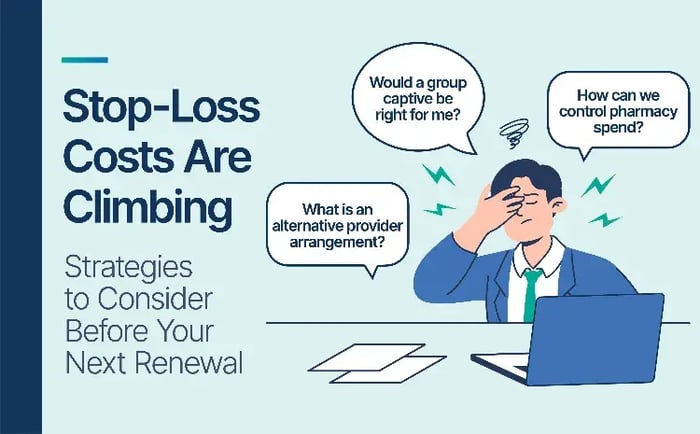
While there is no universal solution, three approaches deserve consideration.
1. Group Captives Offer a Different Way to Manage Risk
As traditional stop-loss pricing becomes more challenging, group captives may offer eligible employers an alternative funding strategy.
According to Brewster, employers with approximately 50 to 500 covered employees may be good candidates, depending on their financial position, claims history, and willingness to participate in the captive's approach to risk management.
He recently worked with an employer with fewer than 100 employees that had become accustomed to annual increases of 15% to 20%, even during favorable claims years.
After transitioning to a group captive with integrated cost-containment solutions, the employer avoided its anticipated increase and is now working toward a flat renewal for its second year.
2. Pharmacy Optimization Can Help Address Rising Claim Severity
Prescription drugs, particularly specialty medications, represent another significant source of healthcare spending.
Employers should understand which medications are driving spending, how their pharmacy benefit manager (PBM) is performing, and where opportunities for cost management may exist.
Through RightTurnRx, 90 Degree Benefits offers a consultative pharmacy optimization framework that helps brokers and employers evaluate available strategies.
This includes examining pharmacy cost drivers, reviewing PBM performance, and identifying potential opportunities through PBM negotiations, performance audits, and available assistance programs.
For self-funded employers, a thoughtful pharmacy strategy can help address underlying claims costs that may contribute to future stop-loss exposure.
3. Alternative Provider Arrangements Offer More Cost Management Options
Narrow networks, direct contracting, and reference-based pricing are among the arrangements employers can explore to manage healthcare spending. Some of these approaches can be incorporated into existing provider networks, allowing employers to pursue potential cost efficiencies while preserving access to care.
Aaron Woods, Vice President of Business Development at 90 Degree Benefits, has seen employers incorporate direct contracts with freestanding ambulatory surgical centers into broader network arrangements.
However, Woods emphasizes that lower claims costs do not necessarily result in immediate stop-loss premium discounts. The financial benefits may instead become evident through improved claims experience over time.
For employers considering narrower networks, successful implementation also requires thoughtful communication.
Ken Cook, Regional Vice President of Sales at 90 Degree Benefits’ San Antonio office, stresses the importance of gaining leadership support before introducing changes that could affect employee access to providers.
Greater Transparency Supports Smarter Healthcare Decisions
Understanding where healthcare dollars are going is an important part of managing long-term claims costs. By partnering with employers to provide transparent claims reporting and cost information, we help identify spending trends, uncover cost-savings opportunities, and support more informed plan decisions.
That transparency also extends to the member experience. Through CareConnect, 90 Degree Benefits leverages existing PPO arrangements to give members access to provider pricing and quality information, helping them make more informed choices about where to receive care.
A More Proactive Approach to Stop-Loss Management
As the stop-loss market adjusts to higher claims severity and tighter underwriting requirements, brokers have an important opportunity to help employers reassess their approach to healthcare spending.
Group captives may provide an alternative way to finance risk. Pharmacy optimization can reveal opportunities to address prescription drug costs. Alternative provider arrangements and informed healthcare decision-making can also contribute to more deliberate plan management.
The right combination will depend on each employer's claims history, financial objectives, workforce, and appetite for risk.
At 90 Degree Benefits, we work alongside brokers to evaluate customized self-funded solutions that address healthcare costs while supporting a positive member experience. Our national resources, local service teams, and comprehensive benefit offerings help employers explore strategies aligned with their long-term goals.
Preparing clients for 2027 renewals?
Connect with 90 Degree Benefits to explore more solutions for managing self-funded healthcare costs.